sales@martinskiphire.co.uk

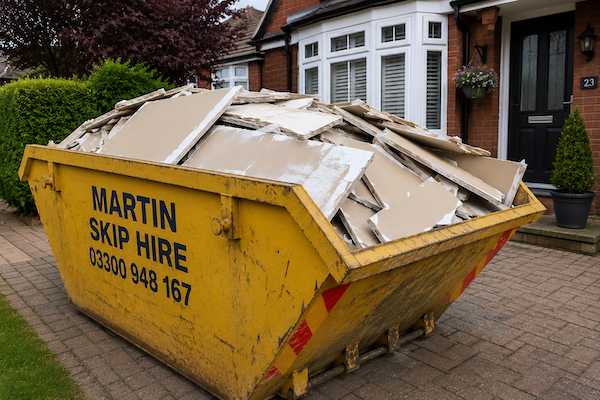
Booking a plasterboard skip isn’t always as straightforward as disposing of general building waste. Because plasterboard contains gypsum, many waste facilities require it to be separated from other materials so it can be recycled correctly. If you’re carrying out a renovation, property refurbishment or construction project, understanding how plasterboard disposal works will help you choose the right skip size and avoid problems once work is underway.
Many people only discover the rules around plasterboard disposal once work is already underway. A few sheets removed during a DIY project may not seem like a significant amount of waste, but larger renovation and construction projects can quickly generate substantial volumes of plasterboard. In these situations, a dedicated plasterboard skip may be the most practical option for ensuring the material is collected, transported and recycled correctly.
If your project involves a mixture of waste types, it’s always worth checking what can and can’t be accepted before loading your skip. Our guide on what can and can’t go in a skip explains the most common waste restrictions, or you can speak directly with our team on 03300 948 167 for advice.
Why Plasterboard Needs To Be Disposed Of Separately
Unlike bricks, concrete, timber and other common building materials, plasterboard contains a gypsum core. While gypsum is highly recyclable, it needs to be processed separately from mixed waste streams so it can be recovered and reused.
This is why plasterboard is often treated differently at waste transfer and recycling facilities. Separating gypsum-based materials helps improve recycling rates and reduces the amount of waste sent to landfill. It also allows the recovered material to be used in the manufacture of new plasterboard products and other construction materials.
For homeowners, builders and contractors, the key point is simple: always let your skip hire provider know if your project is likely to generate plasterboard waste, particularly if you’re undertaking a larger renovation or refurbishment.
When A Dedicated Plasterboard Skip Is The Better Option
Not every project requires a dedicated plasterboard skip. If you’re removing a small amount of plasterboard as part of a minor home improvement project, there may be alternative disposal arrangements available depending on the type of skip hired and the waste being collected.
Larger projects are different. Once multiple rooms, ceilings or partition walls are stripped out, the volume of plasterboard can increase rapidly. In these cases, separating the material from other waste often becomes the most efficient solution.
Projects that commonly generate enough waste to justify a dedicated plasterboard skip include:
Where large quantities are involved, using a dedicated plasterboard skip can make waste management simpler while helping ensure the material is recycled through the correct channels.
Common Projects That Require A Plasterboard Skip
Home renovations are one of the biggest sources of plasterboard waste. Even relatively modest projects can generate more material than many people expect, particularly once walls, ceilings and dry-lined surfaces begin to come down.
| Project Type | Typical Plasterboard Waste | Recommended Skip |
|---|---|---|
| Bathroom Renovation | Ceiling boards, wall linings and damaged plasterboard | 4 Yard Skip |
| Kitchen Refurbishment | Partition walls, ceilings and dry lining waste | 6 Yard Skip |
| Loft Conversion | Insulated plasterboard, offcuts and ceiling waste | 8 Yard Skip |
| Full Property Renovation | Multiple rooms of plasterboard and mixed building waste | 8–12 Yard Skip |
| Commercial Refurbishment | Large quantities of plasterboard from strip-outs and fit-outs | Dedicated Skip |
Choosing the correct skip size from the outset helps avoid overfilling and reduces the likelihood of needing additional collections during the project. If you’re unsure which size is most suitable, our team can recommend the best option based on the type and volume of waste being generated.
What Happens If Plasterboard Is Mixed With Other Waste
One of the most common misconceptions is that plasterboard can simply be thrown into a skip alongside all other construction waste. While small quantities may sometimes be manageable depending on the waste stream, larger amounts can create difficulties during the sorting and recycling process.
Mixing significant quantities of plasterboard with general waste may result in:
This is why many larger projects choose a dedicated plasterboard skip from the beginning rather than attempting to separate materials later.
How Plasterboard Is Recycled
Many people are surprised to learn that plasterboard is one of the most recyclable materials used in modern construction. Once collected, the material is processed so that the gypsum core can be separated from the paper lining. The recovered gypsum can then be reused in the production of new plasterboard products and other construction materials.
By keeping plasterboard separate where possible, more of the material can be recovered and returned to the manufacturing process. This reduces landfill use, supports the circular economy and helps minimise waste generated by the construction sector.
Unsure Whether You Need A Plasterboard Skip?
Every renovation project is different. A small bathroom refurbishment will generate very different volumes of waste compared to a full house renovation or commercial strip-out. If you’re unsure whether your project requires a dedicated plasterboard skip or if you’d like advice on the most suitable skip size, contact us. Our team is happy to help. If you’re ready to hire a skip, we also offer online ordering, making the process quick and easy.
If you’re disposing of a mixture of waste materials, we recommend calling on 03300 948 167. Our expert waste team can help you choose the right skip for your project and advise on the most cost-effective waste removal for your project.